Documentary Script: Format, Template, and 7-Step Writing Guide
Build a fact-based documentary script that connects research, interviews, narration, scenes, and B-roll without forcing reality into a fictional screenplay.

Table of Contents
Searching for a documentary script usually means you need more than screenplay formatting. You may have research, interview recordings, locations, archive clips, and a central question, but no clear order that turns those materials into a watchable story.
The useful answer is not to lock every word before filming. Documentary writing happens in stages: a research outline before production, a shooting script that identifies sequences and evidence, and an edit script that uses the material you actually captured. This guide gives you one structure that can evolve across all three stages.
The key distinction is accountability. Fiction can invent a convenient scene; a documentary must show where a claim comes from, separate observation from interpretation, and preserve the meaning of interviews even when quotes are shortened.
What a Documentary Script Includes
A documentary script is a sequence-by-sequence plan for what the audience will see, hear, and understand. It can contain scene objectives, interview questions or selected quotes, narration, archive references, on-screen facts, sound cues, and notes about evidence that still needs verification.
Unlike a conventional screenplay, the document is expected to change. Before filming, it predicts useful scenes. After filming, it becomes an edit map based on transcripts, timecodes, releases, and available visuals. The format matters less than making every story beat traceable to real material.
| Element | Purpose | When to Write It |
|---|---|---|
| Story question | Defines what the film investigates rather than the answer it wants to prove | Before research and again after major discoveries |
| Sequence outline | Groups scenes into setup, development, complication, and resolution | Before filming, then revised during editing |
| Interview plan | Connects each contributor to a specific fact, experience, or disagreement | Before each interview |
| Narration | Bridges context the images and interviews cannot communicate efficiently | Draft lightly before filming; finalize after the rough cut |
| Visual and archive notes | Identifies B-roll, documents, photographs, graphics, and permissions | Throughout research, production, and clearance |
How to Write a Documentary Script in 7 Steps
Start with the evidence and the viewing experience, not with polished narration. A strong workflow prevents the voice-over from explaining scenes the camera could show more powerfully.
Keep a source log beside the creative outline. For every statistic, historical claim, quote, or archive clip, record its source, owner, permission status, and the exact wording you can defend.
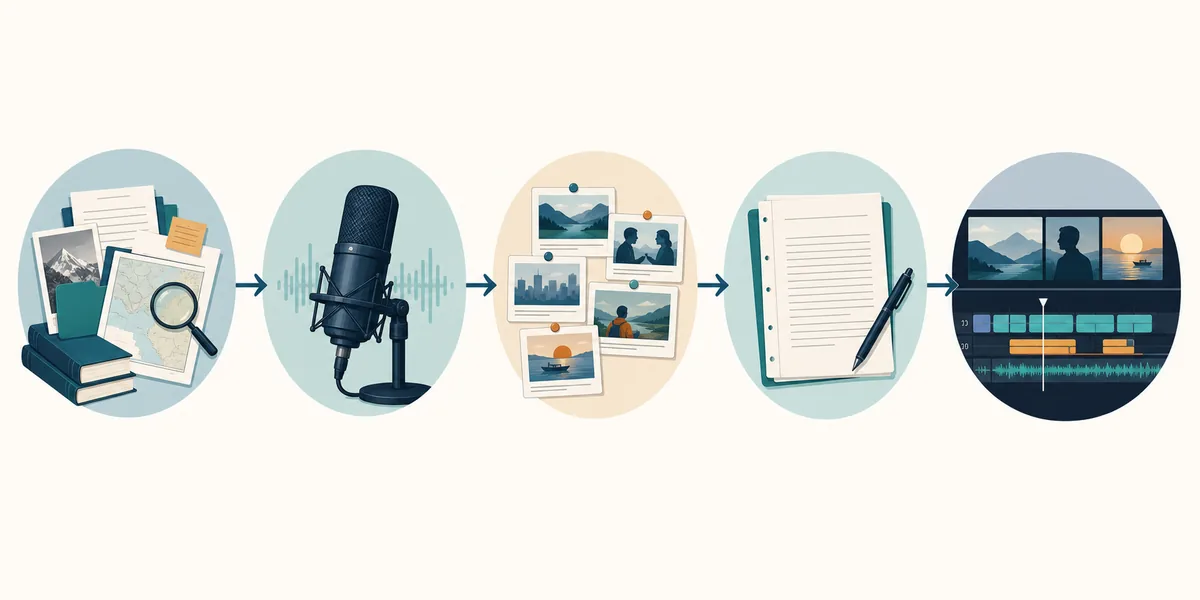
- Write one open story question — Use a question that can survive surprising evidence, such as why a river changed or how a community adapted, instead of deciding the conclusion first.
- Build a research timeline — List confirmed events, disputed points, missing evidence, key people, and access risks. Mark assumptions so they do not quietly become facts.
- Choose a point of view — Decide whose experience carries the audience through the subject and what other voices can challenge or widen that perspective.
- Outline visual sequences — Describe actions the camera can follow: opening a shop, repairing a machine, returning to a location, reviewing an archive, or making a decision.
- Plan interviews by story job — Assign each interview a purpose—firsthand experience, expertise, accountability, context, or contradiction—then write open questions that invite specific memories.
- Draft restrained narration — Use narration for orientation, transitions, verified context, and time jumps. Remove lines that merely describe what the viewer already sees.
- Rewrite from transcripts and footage — After filming, replace predicted quotes with exact timecoded excerpts and rebuild sequences around the strongest truthful material.
Copyable Documentary Script Template
Copy this documentary script format into a document or spreadsheet. Add a source or timecode column if your project has many interviews or archive assets.
Documentary sequence template
WORKING TITLE: [Title]
CENTRAL QUESTION: [What is the film investigating?]
POINT OF VIEW: [Whose journey or access carries the story?]
AUDIENCE TAKEAWAY: [What should viewers understand, not what must they believe?]

SEQUENCE [NUMBER]: [Sequence name]
STORY PURPOSE: [What changes or becomes clearer?]
LOCATION / TIME: [Where and when]

VIDEO / ACTION:
- [Observable action or location detail]
- [Interview setup or archive asset]
- [B-roll that can prove or complicate the point]

AUDIO:
- NAT SOUND: [Ambient sound]
- INTERVIEW: [Speaker + topic or exact timecoded quote]
- NARRATION: [Only necessary context]

EVIDENCE / SOURCE:
- [Source, date, link or document]
- [Verification or permission still needed]

TRANSITION:
- [Question, image, sound, or action leading to the next sequence]
For a short documentary, five to eight sequences may be enough. For a feature, repeat the same unit at a larger scale and track unresolved questions so the middle of the film keeps developing rather than becoming a string of interviews.
How Interviews, Narration, and B-Roll Work Together
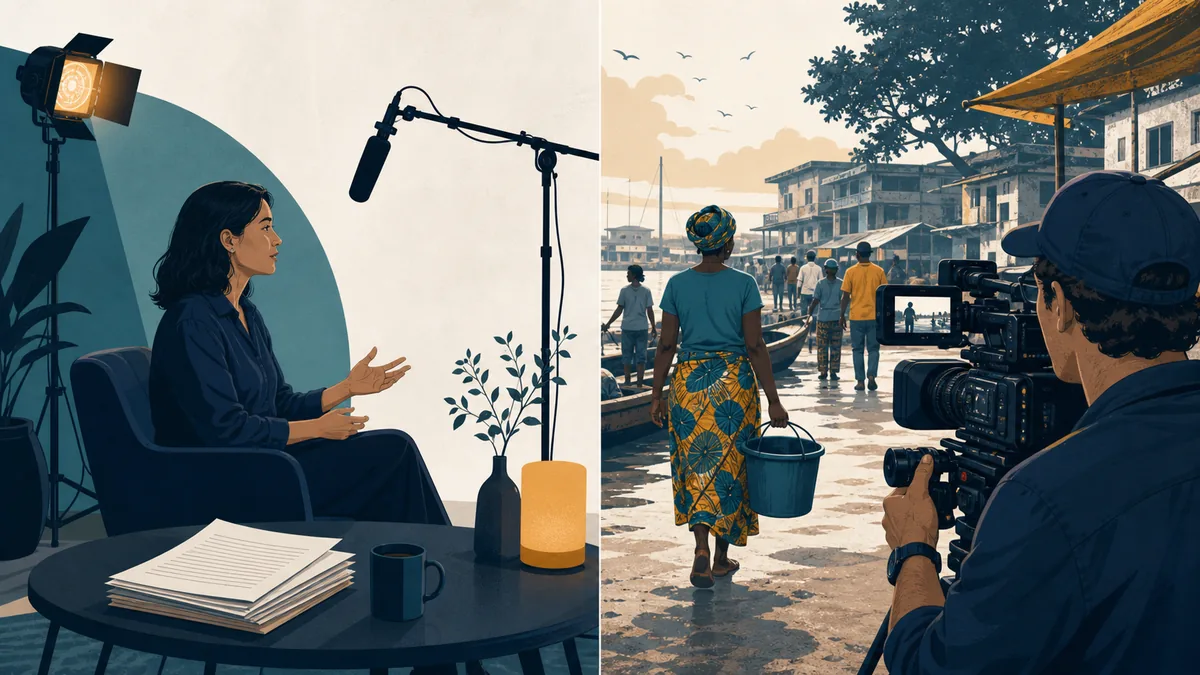
A documentary feels flat when every visual merely illustrates a talking head. Give each source a different job. Interviews provide memory, expertise, emotion, and disagreement. Observational scenes show behavior and consequence. Archive material establishes history. Narration supplies only the context required to connect them.
Write the sequence around a change in understanding. Begin with a visual situation, introduce a claim or question, test it with another source, and end on an image or statement that creates the next question.
| Source | Best Job | Script Note |
|---|---|---|
| Interview | Firsthand memory, expertise, motive, conflict, or interpretation | Use exact transcript wording and retain enough context to preserve meaning |
| Observational B-roll | Action, process, environment, behavior, and consequence | Name the action you need, not generic footage of the location |
| Archive | Historical evidence, contrast, chronology, or prior public statements | Record ownership, date, caption, and clearance status |
| Narration | Orientation, verified context, time shifts, and concise transitions | Avoid telling viewers what to feel or repeating visible action |
| Graphics or text | Names, dates, maps, short definitions, and sourced numbers | Keep the information legible and supported in the surrounding story |
Short Documentary Script Example
This example opens a short film about a coastal market affected by repeated flooding. It combines action, natural sound, interview context, and one restrained narration line.
SEQUENCE 1 — BEFORE THE WATER RISES

VIDEO: Dawn. Vendors lift wooden stalls onto concrete blocks. A faded flood mark runs across a blue door. Mara checks the tide chart taped beside her cash box.

AUDIO: Metal shutters, gulls, carts rolling over wet pavement.

INTERVIEW — MARA (timecode 00:12:18): ‘We used to raise everything once a year. Now we do it whenever the wind turns south.’

ARCHIVE: Photograph of the same market in 2004, with source and permission noted.

NARRATION: City records show that nuisance-flood days have increased over the last two decades.

VIDEO: Mara points to three pencil marks on the doorframe, each higher than the last.

TRANSITION: Cut on the sound of a weather alert to the municipal engineer opening a drainage map.
The sequence does not begin with a definition of flooding. It begins with a repeatable action, lets a participant describe the change, supports the claim with a verifiable record, and ends by moving from lived experience to infrastructure.
Accuracy, Consent, and Ethics Checklist
A polished documentary script can still mislead if it compresses chronology, removes qualifying context, or pairs a quote with images that imply something the speaker did not say. Treat fact-checking and consent as production work, not a final legal cleanup.
When a subject may face personal, professional, legal, or safety consequences, explain the intended use clearly and review the risk of revealing locations, identities, medical details, or allegations. Seek qualified legal review for high-risk claims.
- Trace every factual claim to a primary or reliable source and keep a citation log.
- Confirm names, titles, dates, locations, quotations, translations, and on-screen numbers.
- Do not splice separate sentences into a new meaning or hide a material qualification.
- Label recreations, composites, altered archive material, or illustrative visuals when viewers could mistake them for direct evidence.
- Track appearance releases, location permissions, archive licenses, music rights, and restrictions.
- Give serious allegations a fair opportunity for response and document the outreach.
Frequently Asked Questions
Does a documentary have a script?
Yes, but it is usually flexible. Most projects use a research outline and shooting script before filming, then a transcript-based edit script after the footage is available.
What is the standard documentary script format?
There is no single mandatory format. A practical two-column or sequence format separates video and action from audio, interviews, narration, evidence, timecodes, and clearance notes.
Should I write narration before filming?
Draft only the context and transitions you expect to need. Final narration should come after interviews and a rough assembly so it fills real gaps instead of controlling the evidence.
How long is a documentary script?
Length depends on style and material. A narration-heavy film may approach one script page per screen minute, while an observational film can use a much shorter sequence outline and detailed edit notes.
How do I turn interview transcripts into a script?
Mark the strongest exact quotes with timecodes, group them by story function, check surrounding context, and place them inside visual sequences rather than stacking interviews by topic.
Write the Evidence First, Then Shape the Story
A useful documentary script is not a fictional screenplay wearing factual details. It is a living map that connects a clear question to verifiable evidence, human experience, observable scenes, and ethical editorial choices.
Start with the template, plan one sequence around a real action, and keep your source log beside the creative draft. After filming, let the transcripts and footage change the script—that revision is part of documentary writing, not a failure of planning.
Related Tools and Guides
- Movie Script Template — Compare documentary planning with conventional screenplay scene formatting.
- Video Script Template — Use a concise structure for explainers, tutorials, and online videos.
- AI Movie Script Generator — Develop fictional scenes when your project needs dramatized rather than documentary writing.
- Script to Screenplay Converter — Convert rough narrative prose into screenplay-style scene structure.
References
- Sundance Institute — Documentary resources — Professional context for documentary development and nonfiction storytelling.
- International Documentary Association — Resources — Industry guidance and discussions about documentary practice, ethics, and production.
- BBC Academy — Editorial Guidelines — Editorial principles relevant to accuracy, fairness, privacy, and harm.
Last updated: July 30, 2026
Develop a Screen Story