Podcast Script Template: Free Formats for Solo, Interview, and Co-Host Shows
Plan a natural episode without sounding over-scripted. Copy the format, set a realistic time budget, and adapt the words to your voice.

A podcast script is not a transcript written before recording. It is a production map: it protects the promise of the episode, gives the host clean transitions, and prevents an interview or solo monologue from drifting away from the listener's question.
The best level of detail depends on the format. Narrative shows may script almost every sentence. Interview hosts usually script the opening, sponsor wording, key questions, and closing while leaving room for follow-ups. Solo educators often work best from short speaking blocks rather than dense paragraphs.
This guide gives you a reusable podcast script template, three format variations, a timing table, and a complete three-minute example. Use the template in a document, a teleprompter, or as the input for the free podcast script generator.
The Podcast Script Structure That Keeps an Episode Moving
Every section should either earn attention, deliver value, or guide the listener to the next beat. The following structure works for most educational, branded, interview, and creator-led podcasts.
| Part | Purpose | Typical time |
|---|---|---|
| Cold open | Start with a surprising line, question, or outcome before housekeeping. | 10–25 sec |
| Host intro | Name the show and establish why this episode matters. | 15–30 sec |
| Episode promise | Tell listeners what they will know or be able to do by the end. | 10–20 sec |
| Main segments | Deliver the story, lesson, or interview in clearly separated beats. | 70–85% |
| Recap | Repeat the few ideas worth remembering, not the entire episode. | 20–60 sec |
| Call to action | Ask for one next step: follow, share, download, reply, or continue listening. | 10–25 sec |
Three Copyable Podcast Script Templates
Choose the format that matches the recording. Replace bracketed notes with specifics and delete any line that sounds unlike you.
Solo episode template
Best for tutorials, commentary, reviews, and founder-led shows.
[COLD OPEN]
A specific problem, result, or provocative question.

[INTRO]
Welcome to [show]. I’m [host]. Today: [topic] for [audience].

[PROMISE]
By the end, you will know [outcome].

[SEGMENT 1]
Point, example, and transition.

[SEGMENT 2]
Point, evidence, and practical step.

[RECAP + CTA]
Remember [takeaway]. Next, [one action].
Interview episode template
Best when the guest's experience is the main value.
[COLD OPEN]
A short guest quote or the question listeners most want answered.

[INTRO]
Introduce the guest with only the credentials relevant to this episode.

[OPENING QUESTION]
What changed your view of [topic]?

[CORE QUESTIONS]
1. What happened first?
2. What did not work?
3. What should a beginner do this week?

[WRAP]
One lesson, guest links, and listener action.
Co-host template
Best for discussion, news analysis, and recurring segments.
[OPEN]
Host A: hook and topic.
Host B: tension, counterpoint, or context.

[SEGMENT 1]
Shared facts before opinions.

[SEGMENT 2]
Host A position; Host B response; one example each.

[LISTENER QUESTION]
Read and answer one relevant submission.

[CLOSE]
Agree on the useful takeaway and preview the next episode.
Podcast Timing and Word Count
Most conversational English is about 125–155 spoken words per minute. Pauses, laughter, music, clips, and guest answers reduce the amount of written copy you need.
| Episode length | Approximate scripted words | Good fit |
|---|---|---|
| 3 minutes | 330–420 | Daily tip, trailer, or short commentary |
| 10 minutes | 1,100–1,400 | Focused solo lesson or news update |
| 30 minutes | 2,000–3,000 plus flexible notes | Interview or multi-part discussion |
| 60 minutes | Detailed run sheet, not a full transcript | Long interview, panel, or narrative production |
Treat these numbers as a rehearsal starting point. Read the opening aloud, measure it, and adjust the rest of the run sheet to your actual pace.
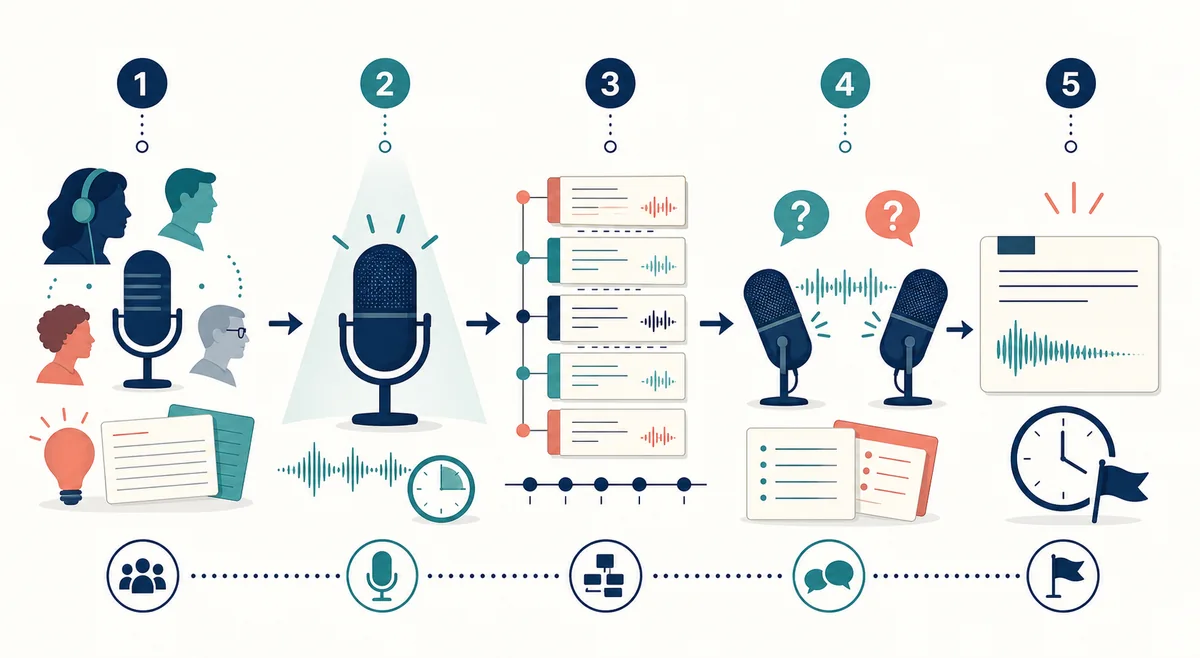
A Five-Step Podcast Scripting Workflow
Good scripts are built from the listener's need outward, not from a blank introduction.
- Define the listener and outcome. Write one sentence describing who the episode is for and the change it should create.
- Draft the hook last. Outline the strongest result first, then write an opening that honestly points to it.
- Build segment cards. Give each section one job, one example, and one transition.
- Mark flexible language. Use bullets for discussion and full sentences only where wording, timing, or compliance matters.
- Rehearse and cut. Remove repeated setup, long biographies, and any paragraph that is hard to say in one breath.
3-Minute Podcast Script Example
This short educational episode uses a tight promise, two practical points, and one action. At a calm pace it lands near three minutes.
[COLD OPEN]
If your podcast intro takes a minute to explain what the episode is about, many listeners have already decided to skip.

[INTRO]
Welcome to Better Episodes. I’m Maya, and today we’re fixing podcast openings that sound polished but say nothing.

[PROMISE]
In the next three minutes, you’ll get a two-line opening formula you can use before your next recording.

[POINT 1: NAME THE PROBLEM]
Start with the moment your listener recognizes: ‘You press record, deliver a long welcome, and still have not given anyone a reason to stay.’ Specific friction creates attention faster than a general greeting.

[POINT 2: PROMISE A RESULT]
Follow with a realistic outcome: ‘By the end of this episode, you’ll know how to cut that intro to twenty seconds.’ The promise should match what the episode actually delivers.

[RECAP]
Problem first. Result second. Show title after attention is earned.

[CTA]
Rewrite your current opening in two lines, read it aloud, and keep the version that sounds like something you would really say.
Notice what is missing: a long biography, several calls to action, and vague claims. The script gives the host enough language to begin confidently while leaving room for natural delivery.
Common Podcast Script Mistakes
A template should make the episode easier to hear, not merely easier to format.
- Writing for the eye: Shorten sentences, use contractions, and mark pauses so the copy works aloud.
- Overloading the introduction: Move history and credentials into the moment they become relevant.
- Asking stacked interview questions: Ask one clear question, listen, then follow the answer.
- Using too many calls to action: Choose one primary action and place secondary links in show notes.
- Skipping transitions: Add a sentence that explains why the next segment follows the previous one.
How to Use AI Without Losing Your Podcast Voice
AI is most useful for turning a clear brief into options: hooks, segment order, interview questions, examples, and alternate transitions. Give it the audience, format, tone, duration, required facts, and desired listener action.
Do not publish the first draft unchanged. Check facts, remove generic filler, replace phrases you would never say, and rehearse the copy. The final script should sound like a prepared version of you, not like an anonymous article read into a microphone.
Podcast Script Template FAQ
Build a Script You Can Actually Say
Start with the listener promise, divide the episode into useful beats, and fully script only the moments that benefit from precision. That balance creates a clear show without flattening the host's personality.
Copy one of the formats above for your next recording, time the opening aloud, and revise anything that feels unnatural. If the blank page is the problem, use the podcast script generator to create a first draft from your topic and then edit it into your voice.
Related Podcast and Script Resources
- Podcast Script Generator — Create a structured episode draft from a topic, audience, and duration.
- Video Script Template — Use a broader template for YouTube, explainers, and short-form video.
- Free AI Script Generator Guide — Compare no-sign-up options and practical workflows.
- AI Movie Script Generator — Explore scene-based dialogue and screenplay drafting.
References
- Apple Podcasts for Creators — Episode creation and publishing guidance.
- Spotify for Creators — Planning, recording, and publishing resources.